Getting a Concept Art Job Without Experience or Degree
 Landing that dream concept fine art job isn't but a matter of talent. Success is when opportunity meets preparedness, and so three to 6 months before y'all start sending out your portfolio, you need to draw upwardly a programme of campaign.
To assist y'all go started, we asked concept artist Eliott Lilly, writer of The Big Bad World Of Concept Art For Video Games, to provide his personal checklist of the ten most of import things to do before get-go your job hunt.
1. Brand a list of your top five studios
Everyone has a dream studio they would love to work at, or a project that they wish they could work on. Your first course of activity should be to do some enquiry on the artists who work at those studios to see what caliber of artwork they accept on their portfolio sites.
Wait at 1 of those portfolios, and compare it to your ain. How does yours hold up? If you lot're just starting out in the manufacture, the chances are that information technology doesn't. Therefore, if you lot employ to your dream studio right now, you probably won't go the chore. And then don't waste your fourth dimension by applying.
Don't worry: all is non lost. Past making a list of unobtainable studios, you have inadvertently created goals for yourself. You can put this list away for now, but bank check back in a few years. Ane solar day, you will put your art next to that of one of the artists you lot researched, and it will exist just as good. That's when you lot volition know information technology is time to use to your dream studio.

Concepts for id Software'due south Rage, created past Eliott Lilly. Comparing your piece of work to that of artists at studios you hope to work for will help guide your job hunt.
two. Now do it over again, but be realistic
Now that you lot know where you ultimately desire to work, look for companies that produce like projects, but aren't in such high demand. These studios might be smaller in size or just less well-known, but they should still allow you to develop a professional body of work.
Write them down in gild of preference, then systematically cheque to see if they are hiring. Studios volition oftentimes list employment opportunities directly on their website, or denote them on manufacture websites, forums or online galleries. [Like ArtStation'south chore section – Ed.] You'll have to exercise a bit of digging, but the jobs are out there. Go along your options open: if, while searching, y'all come up across a studio you hadn't considered before, don't be too quick to dismiss it.
Doing this before you are really in demand of a chore warms you up to the procedure, familiarizes you with the electric current marketplace climate, and alleviates some of the stress when you lot beginning job-hunting in earnest.
3. Have your portfolio reviewed
Earlier applying for a job, have your work evaluated professionally. If yous're notwithstanding a student, you can enquire your teachers; or you can ask other industry professionals yous know. [Some merchandise shows, like Trojan Horse was a Unicorn, likewise run portfolio review sessions – Ed.] Avert asking family members or close friends: they may just tell you what yous want to hear. Request for constructive criticism early on will requite y'all enough time to make whatever changes necessary.
Here are a few good questions to enquire:
• Based on what you saw in my portfolio, what blazon of job do you recollect I will exist best at?
If the answer doesn't line up with your expectations, the chances are that your portfolio does not convey your intent, that you exercise non accept the right images in it – or worse yet, that the quality of those images isn't up to industry standards. Either way, y'all will know that you have piece of work to do.
• What practise you think are the strengths and weaknesses of my body of work?
No thing what answer you receive, exercise not interrupt or try to defend your work – it must stand up on its own! If you don't like the response you get, ask what you lot demand to practice in order to ameliorate.
• What else do I demand in my portfolio to work in [industry sector 10]?
Whether you want to be a grapheme, environment or prop artist, an experienced professional volition know if y'all take what it takes to make information technology in your desired subject field.
Afterward hearing all of the feedback, take activeness. Don't drag your feet or put it off: do information technology at present!

A portfolio review in progress at the Trojan Equus caballus was a Unicorn festival. Getting professional person feedback on your work before applying for jobs is invaluable.
4. Finalize your portfolio website
Information technology's time to start thinking about your website and its pattern. Information technology will need to see manufacture standards to exist taken seriously. You will accept to give thought to where the site is hosted, what kind of content it contains, and even the ease of navigation. Your website should send the message that yous are a young professional person looking for work. If y'all demand aid, visit other professional artists' sites for ideas.
Likewise your artwork, your site should include your resume and contact info such as a phone number or email address. (Avoid including your mailing address, since that's a bit personal: relieve that for the resume.) Since people tend to correct-click and relieve images they like to their computer, brand sure that your website's URL is written in fine impress on every image on the site.
Since fine art directors visiting your website will only spend a few minutes clicking around, y'all have a very brusk window of opportunity. Be sure that the site is easy to navigate, and that there is piffling clutter to distract the heart. No ads, music or flashy animations are needed. It is besides important that your content is optimized as efficiently equally possible to minimize load times.
5. Create a proper resume
Before you apply for jobs, you will need to create a resume listing your credentials, educational background and employment history. Make it as professional person-looking as possible, and go on it nether two pages in length. (One folio is better.) There are hundreds of tutorials on how to practice this online, along with templates yous can download, so just do some Googling. And remember: no typos!
6. Attend industry events
When a videogame is on display at an expo, there is unremarkably either someone from Hr or a studio employee present at the booth. [The same goes for VFX and animation studios at trade shows – Ed.] If you are lucky, they may be willing to look at your portfolio and reply your questions. Getting contiguous fourth dimension with a studio representative is the best way to make a lasting impression, since you are non just showing off your work but your personality. Consider information technology a mini-interview.
If things go well, that person will give you their business card, thereby becoming your contact indicate at that studio. By the end of a trade show, you should have several cards, so write downwards a few notes almost each person you spoke to while they're still fresh in your mind. It is important to note if they had any comments or advice – and more importantly, if they want you to follow upwardly with them.
Remember: before attending trade shows, y'all demand to have completed the previous 5 steps. Without an awareness of which studios yous desire to work for, a solid body of work, and a resume to friction match, you will exist wasting a lot of time and money.
7. Promote yourself
Besides your website and social media, post your work on professional concept fine art galleries. Submit your piece of work to art contests, both online and in impress. Doing so increases your visibility and the gamble that someone might 'observe' you earlier y'all even employ. It will besides give you lot a taste of real-globe deadlines, restrictions and pressures. Even if y'all don't win, you may get a portfolio piece from it.
And don't be afraid to post your work on concept art-related forums in the 'needs assist' department. Non all of the feedback volition be helpful or even relevant, but if you acquire something new, it volition be worth information technology.
8. Connect with professionals
Once you lot have begun to narrow down the studios where y'all want to work, reach out to artists at those studios and show them your work. Ask questions like: "What else does my portfolio demand to be attractive to your company?" Developing a rapport with team members before you apply for the task will improve your chances of getting hired.
You lot should too be connecting to other artists in the manufacture via social networks, public galleries and forums. Grade a human relationship with them past following their blogs, commenting on whatever pieces they mail service publicly, and by sending them the occasional quick email. It is benign for whatsoever artist to be part of a network of manufacture professionals who look out for ane another.
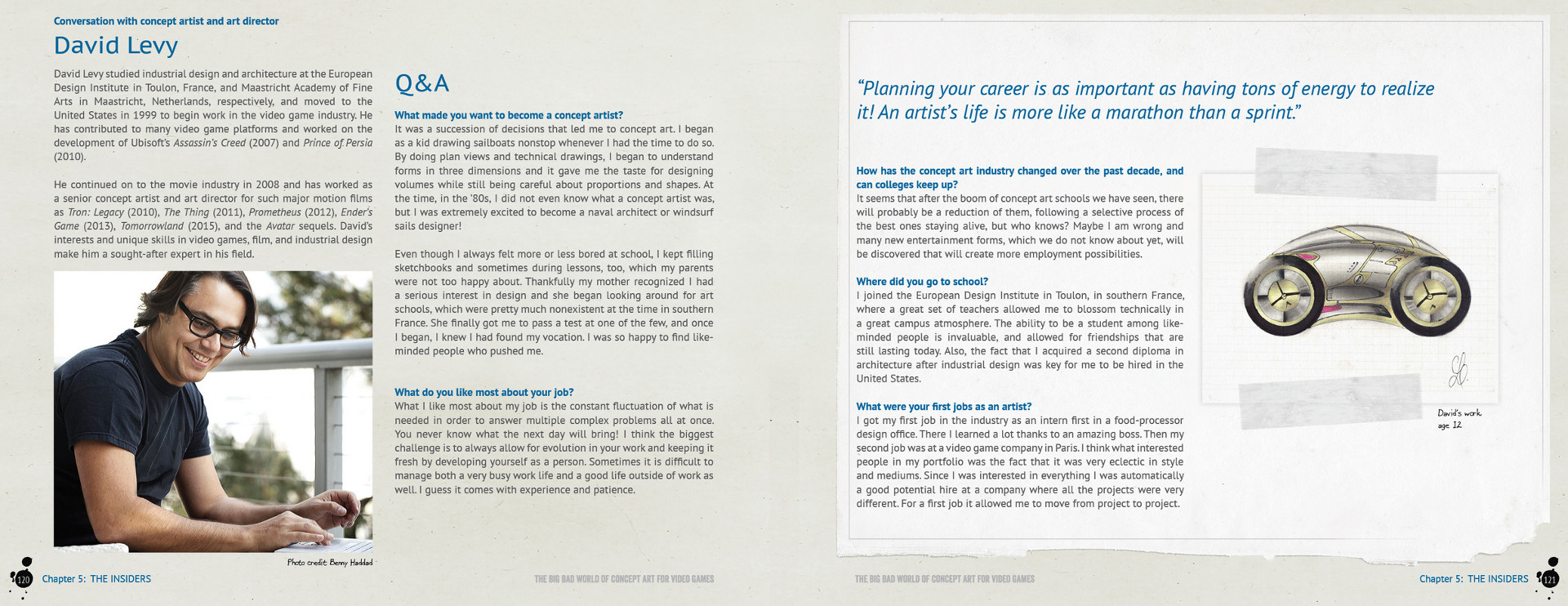
Leading artist David Levy, interviewed in Eliott'southward book, The Large Bad Earth of Concept Art for Video Games. Building contacts with other industry professionals will help your chore search.
9. Stay beside of industry news and events
First taking interest in industry news. Bookmark key games or movie manufacture news sites and visit them for a few minutes each day, skimming articles. During interviews, it helps to know what the current trends in the industry are, so that you can talk nearly them when asked.
x. Go organized
Keep runway of all of your chore-hunting efforts. Document which studios you are interested in, which you have contacted, and with whom yous have spoken. Compile all of your job-hunting resources into a single list, and salve all of the industry-related websites in a bookmark folder in your browser.
Once yous begin to send your artwork out to studios or to other artists, keep rail of what you sent to whom, and certificate any comments or feedback they gave y'all. Trust me, after you've been doing it for a while, it's easy to lose runway!
 By at present, you should have established your job-hunting goals, and created the body of piece of work and other supporting textile that you need to achieve them. When an opportunity presents itself, you can instantly human action on it with confidence. For a more in-depth await at the subject field, check out my volume The Large Bad Earth Of Concept Art For Video Games: An Insider's Guide for Students. Information technology covers in detail what the job of a concept artist really entails, how to choose the right instruction, what you should be studying and practicing in school, how to build a portfolio to land the job you want, and much, much more than.
Eliott Lilly is a freelance concept creative person, adjunct professor, and published author. He has worked in the games industry for well-nigh a decade, and is currently working with Treyarch on Call of Duty: Black Ops three. You tin can observe more data on his blog, or see his artwork in his online portfolio.
Source: https://magazine.artstation.com/2015/07/10-applying-concept-art-job/
0 Response to "Getting a Concept Art Job Without Experience or Degree"
Post a Comment