Neil Gorshch and a Divided Scotus Just Ruled Against Workers Right to Organize Again
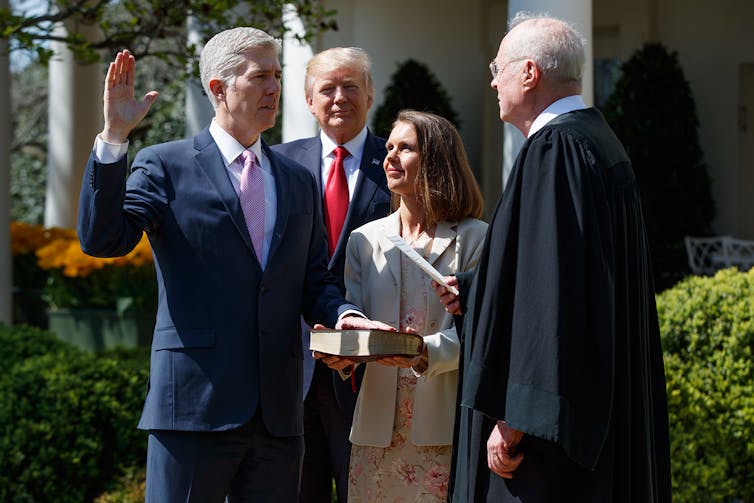
As Neil Gorsuch takes his seat on the Supreme Courtroom, the 4-iv ideological stalemate that plagued the establishment afterwards the death of Justice Antonin Scalia has been broken, reestablishing its conservative tilt.
In an article I wrote last year on the implications of Donald Trump getting the chance to make full Scalia'due south seat, I described how the bourgeois members of the court have long held a 5-4 bulk that routinely ruled for businesses over workers.
So now that they have their bulk back, what does this portend for the court and cases involving worker rights? A careful look at Gorsuch's record demonstrates, I believe, how this will exist bad news for American workers and anyone who cares about economic justice.
Organized religion in the workplace
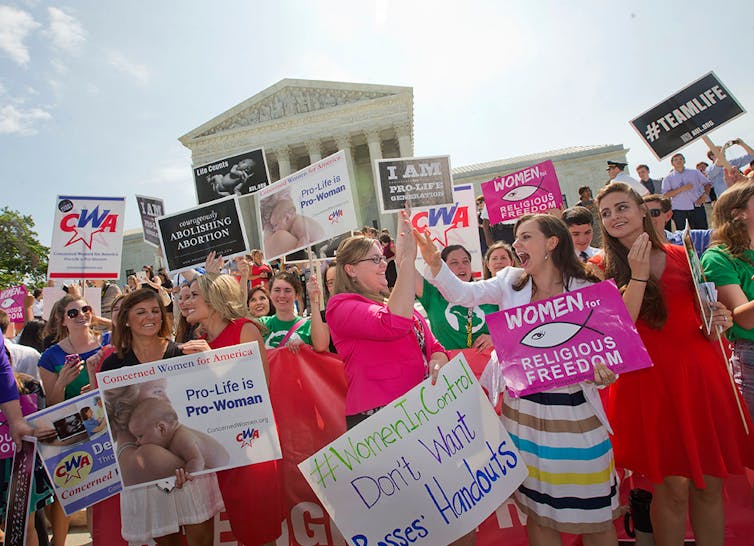
As an appellate judge on the 10th Excursion, Gorsuch joined the bulk in June 2013 granting Hobby Antechamber, a chain of craft stores, the right to deny legally mandated contraception to its workers on religious grounds. The Supreme Court affirmed that opinion a year later.
The primal context here is that limiting women'southward admission to birth control has been shown to increment economic inequality. Without control over the timing and size of their families, women struggle to complete their educations and advance in the workplace. In turn, this depresses their family's income.
Yet Gorsuch and the Supreme Court majority have ranked the religious beliefs of business owners over the health care needs of workers. Indeed, in a subsequent instance, Gorsuch joined a dissent that argued that request a religious organization to only make full out a class to opt out of the contraception requirement is also great a brunt.
This issue is probable to return to the court, where Gorsuch volition certainly suspension a 2016 impasse that sent a like case back to lower courts for resolution. Future cases are also likely to heighten more than conflicts over religion in the workplace.
As Justice Ginsburg warned in her Hobby Lobby dissent:
"Suppose an employer'south sincerely held religious belief is offended by wellness coverage of vaccines, or paying the minimum wage … or according women equal pay for substantially similar piece of work?"
Worker safety and the 'frozen trucker'
So what about his tape on worker rights? His stance in what has become known as the "frozen trucker" case illustrates Justice Gorsuch'south lack of empathy for bluish-collar workers.
In 2009, a truck driver was trapped in his cab later the brakes on his trailer froze in subzero temperatures. Earlier long, the driver was losing sensation in his limbs and having trouble breathing. After calling his employer and waiting for over three hours for a repair vehicle, he unhitched his truck and drove to a nearby gas station. He was fired for abandoning his haul.
The bulk of the three-judge appellate court upheld the Department of Labor's decision that the trucker's termination violated a law permitting drivers to "refuse to operate" trucks in dangerous atmospheric condition. Gorsuch dissented, notwithstanding, arguing the statute did not protect the trucker but instead directed him to "sit and wait for help to arrive (a legal if unpleasant option)."
Gorsuch's narrow and selective reading of ambiguous statutory terms led the bulk to quote his own words from the oral argument dorsum to him: "Our job isn't to legislate and add new words that aren't present in the statute."
Gorsuch's dissent makes clear that he is a textualist, meaning he looks solely to the evidently meaning of a statute without regard to its context or congressional intent in enacting it. Information technology likewise suggests that Gorsuch is out of touch with the realities of life in the modernistic twenty-four hours workforce exterior a judge'south rarefied chambers.
A boon for arbitrators
Gorsuch also appears likely to continue the court'south embrace of mandatory arbitration, which Scalia spearheaded in a series of 5-iv decisions that limited the rights of consumers and employees to have their twenty-four hours in court.
In the employment context, mandatory arbitration means that disputes on issues such as discrimination, unpaid wages and sexual harassment are heard in a private forum that has no right of appeal and favors businesses. Mediation agreements are ordinarily cached in the fine print in one-sided contracts, and well-nigh employees have no option but to sign if they want the job.
In his ain jurisprudence, Gorsuch generally enforced the presumption in favor of arbitration, even where the contractual terms were contradictory or ambiguous. His views on arbitration volition become clearer when the Supreme Court hears a pivotal case in October that will determine whether employers can evade class actions past forcing workers into individual arbitrations.
These grade activity waivers are increasingly pop among employers, yet they destroy the ability of employees to bring cases together that would individually not attract a lawyer due to pocket-sized dollar amounts.
Furthering unions' decline
Finally, Justice Gorsuch is expected to align himself with Justice Scalia's disquisitional views on organized labor.
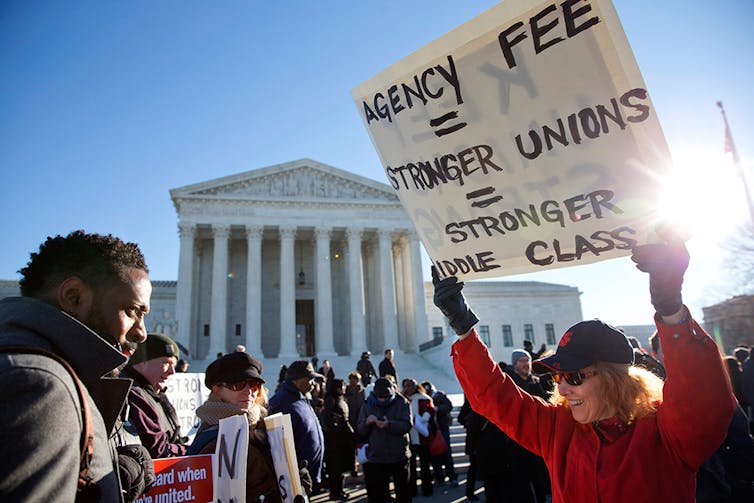
Justice Scalia'south death in February 2016 granted unions a reprieve in a example involving the constitutionality of requiring public workers to pay their fair share of spousal relationship dues, even if they aren't members. That case was decided just a few weeks later in a 4-4 split that left a lower court's decision upholding such fees intact.
The effect is certain to return to the court in the future – with Gorsuch a likely fifth vote to rule confronting the unions.
Marriage membership is associated with a wage premium of xiii.half-dozen percent as compared with nonunionized workers, according to the progressive think tank Economic Policy Institute. At the same time, the decline in matrimony membership is a factor in growing economic inequality due to the wage depression suffered by union and nonunion members alike.
President Trump claims to be a champion for America's forgotten workers. Yet his main accomplishment in his commencement 100 days is the engagement of Gorsuch.
For all the reasons I've outlined, I expect the appointment of Gorsuch to undermine the rights of workers, including Trump'southward supporters, and farther weaken the eye form.
Source: https://theconversation.com/what-gorsuchs-conservative-supreme-court-means-for-workers-76196
0 Response to "Neil Gorshch and a Divided Scotus Just Ruled Against Workers Right to Organize Again"
Post a Comment